miércoles, 28 de octubre de 2015

THIRD WEEK IN BOGOTA


This week was very intense, because I thought the agreement not follow the 2015. This week has been the most liked for its large number of activities and teaching techniques.


Monday: Identifying the development needs for Teaching practice
Monday starts with an activity to identify the kind of teacher I am. I discovered that my role as teacher is between constructivism (guide, facilitator, listener) and social constructivism (together, co-learner)


Then we work with the tree, where the leaves correspond to our abilities as instructors and roots are the needs and desires to improve.


The central part of the day was the elaboration of the idea of class work plan. In it, each of us wrote what we want to do with the training plan and the questions that motivate the class session


At the end of Monday afternoon, the different strategies used were:


Tuesday: Planning learning processes: Learning outcomes, contents and methods 
On Tuesday we used a shooting to indicate how we felt about the use of didactic techniques.


As an icebreaker activity (warmup) was used The king is dead, each showed their artistic talents to tell another that the king died.


We completed a test on teaching methodology. In this format each of us said what are the strategies used in their classes.


Wednesday: Learning environments for individual and collaborative learning, Get Together - party
I lost the pictures of that day :(


Thursday: Guidance and counselling
The session was focused on learning outcomes.

Other activity was Guidance and Counselling. In groups of three, each of us took a role: guidance counselor, counselee and observer. The counselee talks about a problem of education, guidance counselor listens and asks the right questions and the observer looks as the conversation developed. After about 15 minutes the roles are rotated.

This activity was significant to me by the possibility of providing learners to participate in a discussion and take control of its findings and right for put them in the discussion time.

After the fourth day, they were teaching strategies that worked in class.


Friday: Learning materials for diverse and multisensory learning; wrapping up the week
Friday was a session focusing mainly on two aspects: The selection of appropriate strategies for each apprentice and assignments for next week contact.

The activity was oriented to the use of fishtail to search all the advantages of a subject, in this case a good presentation.


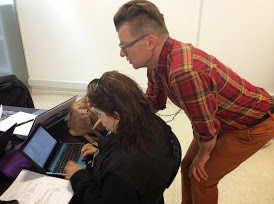
On Friday afternoon we focus on answering questions about the tasks for the next week of contact. Katri explain step by step what should be done in the teaching practice plan.

After a week of work, these were all used teaching strategies.

domingo, 25 de octubre de 2015

MODULE 3 - PREASSIGNMENT - PLANNING AND IMPLEMENTING TEACHING AND GUIDANCE & COUNSELLING


Everyone reads all articles and reports mentioned below, and makes personal notes (aim to find out what is relevant to your teaching, what ideas you can use in your work)
Organise a study circle meeting with your team and discuss your findings; make a summarizing memo as a team and post it on Moodle
Articles for the study circle (On Moodle)


Hyppönen & Linden 2009. Handbook for teachers - course structures, teaching methods and assessment, pages 1-55. 

Karjalainen et al. 2006. Give me time to think.

Kennedy et al. Writing and using learning outcomes: a practical guide

Oblinger 2006. Leading the Transition from Classrooms to Learning Spaces


After reading all documents, each of us made their views on reading, with these, we perform the following essay.

READING REPORT – THE BEANERS


“Teaching in a teaching act is an interactive and goal-oriented action that aims to influence the learning and personal development of students (Kansanen 2004, 58; Uljens 1997, 35–36).The common goal for both parties of the teaching act is to evoke high-quality and deep approach to learning (Nevgi & Lindblom-Ylänne 2004, 236). The task of the teacher is to enable learning by supporting the prerequisites of studying (Uljens 1997, 35–36).”

This part of the book reflects what is teaching itself, in the SENA we have to think that students are a real part of the teaching act and the teaching-learning process will be meaningful.

When planning a course, a good starting point is the definition of the learning outcomes set for the students. These goals help to direct the direction and depth of learning and form the basis of assessment. As you set the learning outcomes, you should take into consideration the existing knowledge of the students and the relations of the course with other courses to promote cumulative and comprehensive learning.

Here also we can see how important is to learn from student needs to make them part of the planning process that way they feel that they learn what they really need.

Teaching comprises the used teaching methods and the teaching style. Teaching methods refer to the techniques used by the teacher. Different teachers may use the same teaching methods to teach the same subject matters, but they may still teach very differently. Therefore, different teachers support various types of studying and guide their students to different learning processes. In this case we as a teachers are free to use different styles and methods the idea is keep students interest.

In the chart we can see the differences between learning-based and content-based which lead us to focus our teaching in a student centered learning to involve them in the process, learning based is the new approach for planning teaching and learning.

The quality of a course here refers to the quality factors conveyed through teaching, exercises teaching material, assessment and methods that have an effect on the studying and learning of students. If we use students centered approach we must use everything we can to get the students outcomes. And also we have to recognize the different learning styles of students and which are academic or non-academic.

There is also the workload, from the teacher’s point of view, workload is affected by the extent of the course and the used teaching and assessing methods as well as teaching experience, experiences in teaching situations and familiarity with the used methods. Also students have their own point of view of the workload and basically has to do with the time spent in planning or studying. But the workload depends on the planning. In this part it´s also mentioned how independent study can get outcomes in some cases lead to learn more than in a contact class.

Working methods are the actions made to organise teaching in order to achieve a higher quality of learning. There we have some different methods according to the teaching situation. It is important to use different methods and to have in mind how students learn and according to that use the method.

Now we can use as many methods as we want in the document we can find 41 different methods some are difficult but most of them can be performed for the students easily.

In the article “Writing and Using Learning Outcomes: a Practical Guide” presents the progress and methodology required to write modules, taking into account the learning outcomes and the following questions: "what did you do to obtain your degree?", "what can you do now that you 'Have obtained your degree?".

Currently there has been a change in teaching, leaving aside the teacher as the center of the process and going for a protagonism to what students should know and do when the course ends. “This alternative model focuses on what the students are expected to be able to do at the end of the module or programme.”

A learning outcome should focus on what the student is required to show when you finish learning activity and not on what the teacher thinks he should learn.

A good starting point for writing learning outcomes is to use the work of Benjamin Bloom, in which he develops three domains of learning:

   Cognitive domain: “is concerned with what the students can do at the end of the learning activity.”

  Affective domain: “is concerned with issues relating to the emotional component of learning and ranges from basic willingness to receive information to the integration of beliefs, ideas and attitudes (“attitudes”, “feelings”, “values”).”

   Psychomotor domain: “emphasises physical skills involving co-ordination of the brain and muscular activity.”

Bloom also considers that the student goes from simple to complex. He organized thinking processes in a hierarchy.

For this, He developed a classification of thinking behaviours, which has served many teachers to create teaching materials and evaluation. They use the taxomony because it provides a ready-made structure and list of verbs.

This taxonomy for the cognitive domain is composed of six levels: knowledge, comprehension, application, analysis, synthesis and evaluation.

For the affective domain is composed of five levels: receiving, responding, valuing, organisation, characterisation

For the psychomotor domain is composed of five levels: imitation, manipulation, precision, articulation, naturalisation

To link learning outcomes with teaching and evaluation is necessary to consider to be written in such a way showing consistency between the results, the techniques of teaching and assessment, and evaluation criteria.

The article “Leading the Transition from Classrooms to Learning Spaces”, presentado por Diana Oblinger, shows the importance of understanding that the concept of space, time, have changed with the use of internet, the notion of a classroom has evolved, learning spaces and can encourage or hinder learning styles.

That is why learning spaces is analyzed. the implementation of these new spaces requires a higher investment capital, but considering that these spaces have a duration of about 50-100 years compared with the technology and team, so the importance of learning about design spaces (places designed for regular meetings of teachers and students face to face).

Before designing a learning space, we recommend various analyzes and gathering information as disciplinary requirements (laboratories, study spaces, project rooms). Then the spaces must be associated to the project's needs is required. In the case of SENA, different laboratories are required in different fields, in order to obtain a good learning environment. At the same time, the design must take into account the size, duration of classes, the kind of space, interaction; and to achieve this it is necessary to involve professionals outside the institution.

Likewise, interactive fields based on learning theory, research, current understanding, research and the new generation of students (all used the Web), create their own knowledge under a principle of active learning: Working together to approach real problems, interact with people outside the classroom, discuss in role-playing simulations and analyze field trips.

When the gaps between existing pedagogy and the emerging pedagogy are analyzed, it can be noted that the first may be related to the exploration and collaboration experience, and the second with connections inside and outside the classroom and wireless access. Spaces are provided to enhance learning spaces designed for comfort, safety and functionality, accessibility for disabled students both onsite and virtual.


With ideas and previous data we conclude that learning spaces should be built to improve learning considering man and society, the philosophy of the institution and its formation rate, the curriculum, technological changes. This shows the need to improve the designs and develop specific actions to achieve quality education.

MODULE 2 - ASSIGNMENTS - MEDIA COVERAGE ON EDUCATION, SOCIETY AND CULTURE


This is how the implementation continues:
  1. Each week till 24.11., find a text, video etc. that covers a theme of education in regard to society and/or culture (e.g. a newspaper article, a YouTube video, a news piece on TV…). In you Google Community, write a short introduction and add a link to the original (if link s available). If the article only is available on paper (that is, no link is available), write your own introduction plus a little bit bigger summary of the article. 
  2. Discuss the articles in your team meeting, write a memo, and add concept(s) and link(s) to the mutual mind map at Mind42 (you need to create a free account to access the mind map at http://mind42.com/mindmap/1e572d49-7981-4f31-a350-30b0a7138418. I have also sent you all an invitation to edit the mind map, but even with the invitation, you first need to create an account). 
  3. I will later add links to some articles you should use in analyzing the links and the mind map, but at first you can get started with your own reasoning! 
  4. This topic should be discussed in the Google Community, but you may also reflect the ideas in your blog. All you need to submit to Moodle is a link to your community (+a link to your blog entries). No additional submission is needed.


Colombia is a model in education for Morocco


Day of educational excellence


Colombia requests the continent to support creation of Inter-American System of Education


Las Mentiras de Gina Parody. (Parte 1)


Verdades y mentiras sobre el paro de maestros

THE BEANER ON DIPITY


During the second week, Irmeli explained to us several tools. One was Dipity.
With this tool we can make timelines.

For this activity, our group The Beaners made a timeline for our work during these two modules.


MODEL OF DAVID KOLB


MODEL OF DAVID KOLB

Wikipedia say about David Kolb:
"David A. Kolb (born 1939) is an American educational theorist whose interests and publications focus on experiential learning, the individual and social change, career development, and executive and professional education. He is the founder and chairman of Experience Based Learning Systems, Inc. (EBLS), and a Professor of Organizational Behavior in the Weatherhead School of Management, Case Western Reserve University, Cleveland, Ohio. Kolb earned his BA from Knox College in 1961 and his MA and Ph.D. from Harvard University in 1964 and 1967 respectively, in social psychology."

But more than his biography, the most interesting is the model that relies on four elements:
  • Concrete experience, 
  • Observation of and reflection on that experience, 
  • Formation of abstract concepts based upon the reflection, 
  • Testing the new concepts, 
  • (repeat). 
Searching in google I found this very intersante link. Kitzia Garcia, Eduardo Herrera and Sara Luevanos made a video showing in detail the model of Kolb.


From about three years ago, since my admission to SENA, I used the model of Kolb with new apprentices to help them identify as they learn. I prepared my own presentation on learning styles, considering not only the model of Kolb. I start with an understanding of the brain, then go to the cerebral hemispheres, later I explain to the schemes of representation (visual, auditory, kinesthetic), after I work Kolb's model and finally I explain the model emotional intelligence.


SENA used this model because it believes supports its pedagogical model and takes into account the work to be performed by a person to learn a skill, that is, so that person can become competent:

  • Act, 
  • Think, 
  • Theorize and 
  • Experiment.


EDUCATION, SOCIETY & CULTURE - MIND42


MIND MAPPING

We used in this activity MIND42, it's a free social and collaborative online mind mapping software.

For this activity each should help build the map on EDUCATION, SOCIETY & CULTURE. The map is divided into nine branches and with the collaboration of each of us a summary of what our culture and our society has got and how it relates to education. 


One of my contributions to this map was not one less program, which aims to bring all children to the classroom, than economic, social or violence problems can not asit.


SECOND WEEK IN BOGOTA


EDUCATION, SOCIETY & CULTURE


This week was encounters with new friends and companions in this adventure called Haaga Helia.


LEARNING CAFÉ
 

One of the most significant activities of the week was the learning coffee, with Finnish tastes. Besides the delicious products, the strategy seemed a suitable for discussions on the topics that work in my classes.

I think the mix of conversation, analysis of issues and food, makes the learning process more interesting for apprentices.


LEARNING THEORIES POSTER
 

Each of the four groups presented their poster on the theories of learning that each collaboratively made during the previous weeks. The most interesting thing for me in this activity was to discover that the SENA model has immense potential and that what is needed is in progress and that all instructors know him thoroughly.


BLOG
 
The purpose of activity to create and configure the blog. My blog would be my way of publicizing the activities, reflections and discoveries that I was doing during the weeks before each meeting. Although I had already worked blog, I had not given much importance in my work as a teacher. The challenge for me was to start using it more frequently. I'm not really very loving to write and publish on the web, so this activity was and will be a challenge.


COPYRIGHTS AND CREATIVE COMMONS

During this session, Irmeli showed us several tools that allow us to search for materials with permissions to be used for educational purposes. 
We also do activity with respect the Kolb model and publish in the blog, a timeline on Dipity our collaborative work on The Beaners

and a collaborative mind map on Mind42 on the central theme of the contact week: EDUCATION, SOCIETY & CULTURE.


SHOWING OUR CULTURE & SOCIETY
 

After the study day, we went to the bar of the SENA hotel. 
Irmeli, Pekka and Matti could taste a typical Colombian PICADA (sausage, blood sausage, pork, beef, potato), listening and dancing to music of our country, listen to our partners Jairo and Fernando who sang and played the flute; and maybe They understand a bit of our culture. 

In the hotel bar, the apprentices who make their practices, attended to us. 
 

Those hours were very funny. 


PROBLEM-BASED LEARNING


Matti use triggers strategy to establish a parallel between culture in Finland and Colombia. The groups met to make a mental map with what is wanted to show about the relationship between education, culture and society. Our group used as a central idea one vueltiao, a tipical hat in our country.


EDUCATION, SOCIETY AND CULTURE – WORKSHOP
 

Each group should make a class session, applying the concepts of pedagogical models.